
Proof of Existence

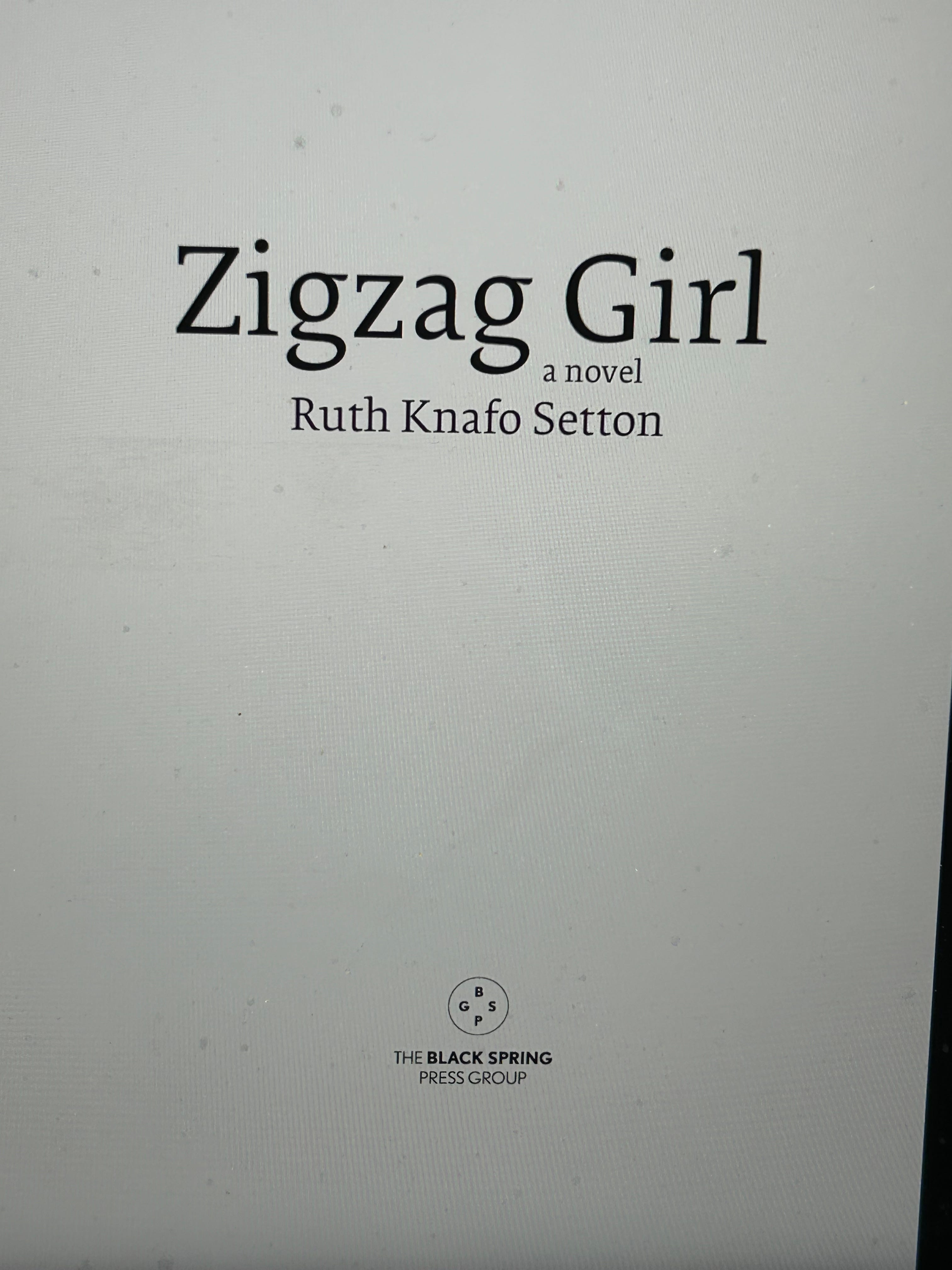
Friends— This week I’ve been working on the proofs of Zigzag Girl. An exhilarating and bittersweet task.
The proof as proof. The moment that the manuscript transforms from possibility to fact, from something that can still be abandoned or reimagined to something that has weight, heft… an ISBN number!
Seeing the words I wrote, reliving the experience of writing them. Seeing what I could have done but also seeing what I actually did. Seeing the scenes that were cut, but that hover behind the words. Like ghosts, rising from the past—reminders of what could have been, and what was, briefly.
A book is always more than what you see on the page. It’s the heart-ache of writing draft after draft that no one will ever see. The joy of getting something right. The excitement—when the words actually shiver on the page. The cool black on white that masks the turbulent storms of emotion, the bursts of inspiration, the tears and laughter, the passion and drive that keep the writer from giving up.
Stopping at a sentence and straining to recall when I wrote it. How I wrote it. Why I wrote it. The emotions rising between the words might be partly about the realization that what was once fluid and changeable is now crystallizing into its final form. The ghosts aren’t just memories but also all the alternate versions, the paths not taken, the sentences I cut, the different endings I considered. They hover there, visible only to me, while the proof itself marches toward its singular reality.
It’s not just memories haunting the text, but the past self who wrote it haunting the present self who reads. There's something powerful about how proofs force you to confront both what you wrote and what you meant to write, the gap between intention and execution becoming visible in a new way. It’s like watching a magic show from backstage—seeing the props and loads, the preparation—and then watching from the theatre auditorium and seeing the finished performance.
One scene was inspired by watching female magicians practice card tricks and flourishes at an outdoor café in Las Vegas on a gorgeous summer evening.
Another was haunted by the mystical memory of attending a drum circle in the Nevada desert through the night and watching the sun rise.
And yet another was when I was locked into a regulation straitjacket—no tricks, no gimmicks—and struggled to break free in front of a group of male magicians who watched encouragingly… and cheered me when I finally escaped.
And one more—here’s a scene I wrote that didn’t make it into the final draft, but that inspired so much of what did remain. I visited an old ballroom in a casino-hotel on the Atlantic City boardwalk. It was called a ballroom, but it was actually a small, intimate space with windows through which you could see the Atlantic Ocean… and a portal into the past.


My main character, Lucy Moon, is picturing the historic ballroom in the Old Tower, and how it must have been during World War Two, when Atlantic City was taken over by the Army. Jinx is the ninety-plus-year-old journalist who covered World War Two, and who knew Cleo, the glamorous magician’s assistant, and her lover, Frank…
I see the sun-dusted Crystal Ballroom in the Old Tower of Midnight, with its great windows and two stages, one at either end, where the big bands used to play. A couple years ago, an old-timer took me inside. In a quavering voice, he told me, “Tommy Dorsey played one end and Artie Shaw the other. In the center of the room people danced, swayed, moved to the rhythm of the horns and drums. Can you picture it, Lucy?”
Oh yes, I could picture it. What an astounding experience it must have been to dance to competing bands under swinging chandeliers while across the sea the war raged. But it was night, and the boys might be sent back to the front tomorrow, and the girls wanted to touch them and be touched and feel alive.
“Cleo dancing in her emerald-green dress,” murmurs Jinx.
Startled, I blurt, “I saw her.”
Silence.
“Who did you see?” asks Jinx.
“I was inside the Crystal Ballroom.” Elegant dancers whirled around the room, but one stood out. “I saw a woman in bright green dancing with a soldier in uniform. One arm in a cast, the other wrapped around her.”
They swayed in place, eyes on each other, whispering. I wanted to hold them in that circle of promise.
Before everything shattered.
It’s a kind of emotional archaeology—each correction is like a small excavation, revealing layers: the day I wrote that particular scene, what was happening in my life when I chose that metaphor, the person I was when that character first spoke to me. Some passages feel too raw now, others surprise me with their prescience—they sensed where I was going before I knew.
The title “Zigzag Girl” itself suggests a kind of indirect path—one that mirrors the zigzag writing process, the way a book moves through time, from conception through drafts to proofs to readers, never quite linear, always doubling back on itself. That movement from dream to reality—it’s both triumph and loss, isn’t it? The infinite possibility of the unwritten book giving way to the beautiful limitation of the actual one.
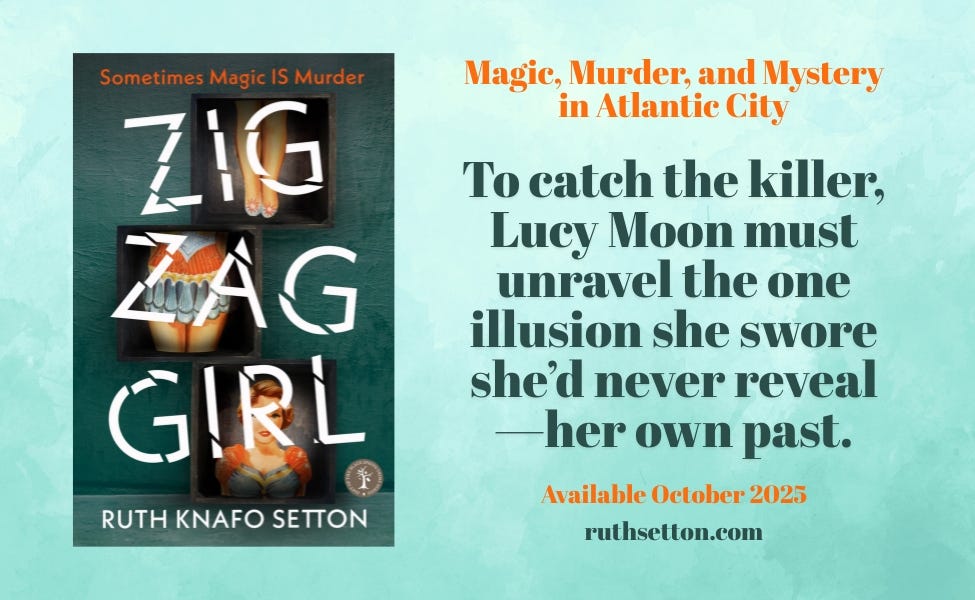
And it’s coming your way on October 23rd. A book you can hold and read, characters I hope you fall in love with. It’s Gothic and romantic and dangerous and funny, and it’s my gift to you.
Tomorrow, I’m leaving for Bouchercon, the crime conference, in New Orleans—the city where Joe and I spent our honeymoon. More emotional archaeology! I’ll be pitching Zigzag Girl and speaking about screenwriting on a panel, and getting beignets and chicory coffee at the Café du Monde….
I’ll leave you with these lovely words from two crime writers I deeply admire, William Boyle and Sarah Hilary:
Ruth Knafo Setton’s Zig Zag Girl is provocative and compelling, a work of fierce imagination. It sweeps the reader up in the uncanny magic of Atlantic City and the New Jersey Pine Barrens.
Lucy Moon is a character for the ages.
--William Boyle, author of Saint of the Narrows Street
Action-packed and thrilling, but it's the extraordinary cast that really make this sing. Pure magic.
—Sarah Hilary, author of Black Thorn
See you next month!
Ruth
Ruth, I'm so thrilled for you and can't wait to read Zig Zag Girl and hold my copy in hand! Have a wonderful time at the conference!